
The 10 Steps of Compelling Goal-Setting
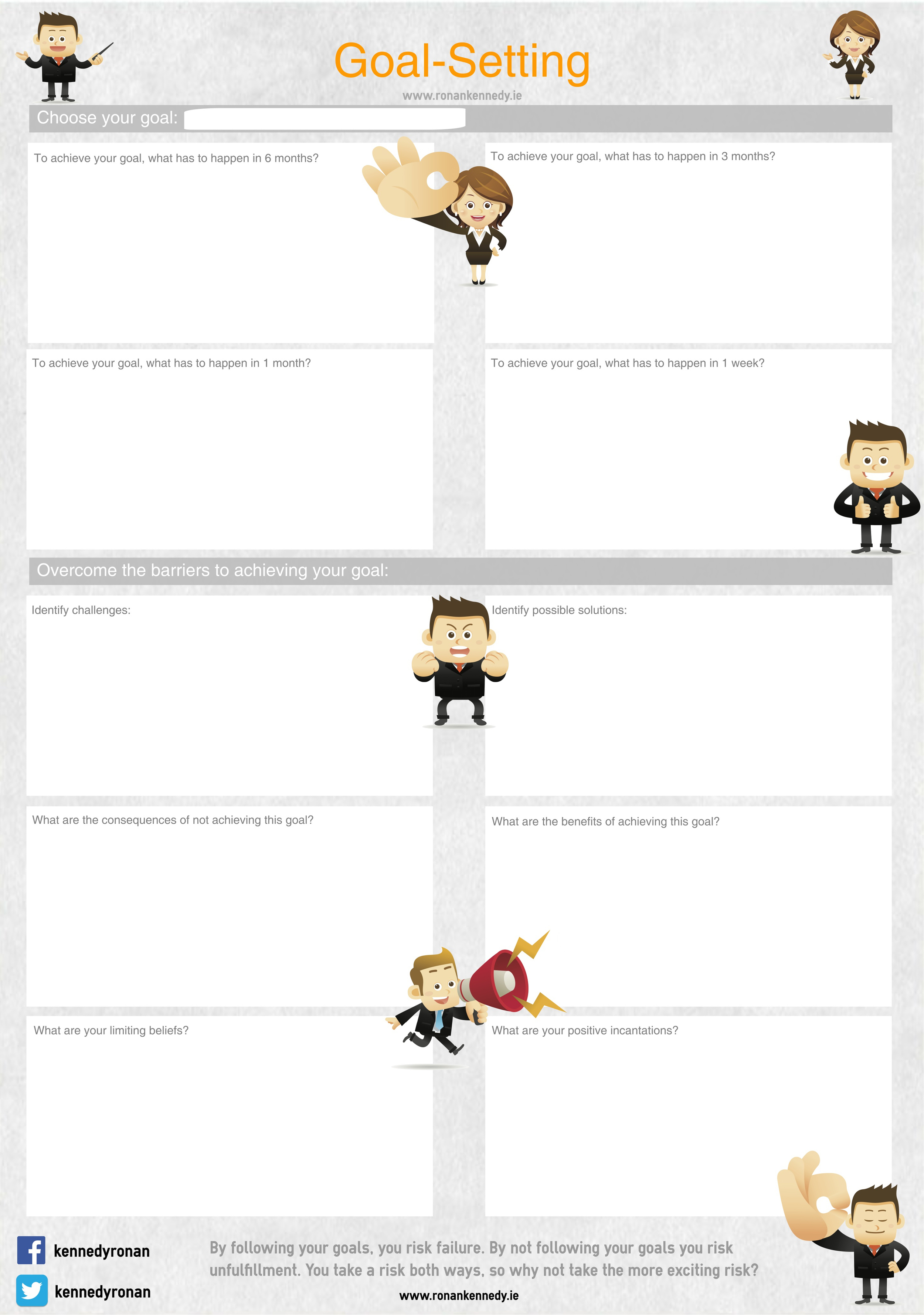
Download the PDF here
Create a vision


Step 1. Write down your vision at the top. (e.g. Change jobs, lose weight, run a marathon etc.)
Step 2. Then, break the process down into small steps starting with what you need to do in 6
months, then 3 months, 1 month and finally 1 week.
Step 3. Be very clear about the steps to achieve this and seek advice from professionals if needed.
Step 4. See the examples above for more information and tips.
Identify challenges and possible solutions


Step 5. Write down challenges that you think you may face along the journey. You don't need to be sure of them but just noting them with help you predict them in advance.
Step 6. Write down the possible solutions for the challenges. These don't need to be definite solutions. The idea is that if we start to search for solutions now, they'll be easier to find in the future.
Understand the consequences and benefits


Step 7. Write down the consequences of not achieving your goal. What will it cost you? What will it cost your family and friends. What will it cost your career or health? How will you feel?
Step 8. Write down the benefits? What will it mean for you? What will it mean for the people you care about What will it give you? What will it allow you to do? How will your life be?
Acknowledge limiting beliefs and create positive incantations


Step 9. Limiting beliefs are things that we sometimes believe are holding us back and preventing us from doing what we want or need to do. The difference between limiting beliefs and real limits is that real limits are definite proven facts, whereas limiting beliefs are just beliefs. (e.g. "I can't run a marathon because I don't have the right body frame", Or "there are no jobs out there!"). We don't know these for sure or often the facts are against us but we still believe that they are obstacles for us. If you believe you can't run a marathon only because of your body frame, we would have to know for sure that no-one else with your body frame has ever done it before to know that it's a limit. And even then, it's not necessarily a limit.
Step 10. Positive incantations involve creating words or phrases that you can say to yourself to counteract limiting beliefs. Words have a unique meaning to each individual so it's important that we use them well (e.g. "I'll find a way", "just do it", "back yourself")
Finally, put your goal-setting chart on your wall, take a photo with your phone or put it anywhere else that is in your focus. That way you won't forget what you need to be doing to make progress.
I hope this post have been of help to you. Feel free to contact me for more information, comments or questions. Thanks, Ronan

This is a guided email-based program designed to help you make significant progress in your career over the span of a 90 days.
Through a series of emails, tasks and resources, you will gain clarity, develop skills, and take action towards your career goals.
You’ll receive an email every 3 days sharing tips, strategies and insights into developing your career and changing jobs.
You can also follow on YouTube if you prefer to watch videos — or both! The choice is yours!

Brian Daly is the managing director of Shelton Distributors, a confectionery distributor with over 2000 clients nationwide. With over 20 years of experience in FMCG trading, Brian talks to us about commercial planning, relationship building and negotiation, and even touches on the impact his executive coaching course has had on his leadership style.
I love the emphasis Brian puts on building relationships and meeting people individually as a way to negotiate and make deals that work for both parties. He highlights how having a people-centric approach is not just a nice way to do business, but also an effective way to create opportunities.

Jonatan Ramhöj is a front-end engineer with over a decade of experience. In this interview, he tells us about his career journey and insights into the world of software engineering.

“As a product manager, you have to be an expert on your users, their problems. You need to be an expert on the business, what matters to the business. And you need to figure out a way to solve their problems in a way that also achieves your business objectives—finding the middle ground of what the business cares about, what the users care about, and aligning a product vision that helps you to sort of check both boxes.”

Lucie Cunningham is the founder and CEO of THE HomeShare, a not-for-profit organisation which provides a cost-effective solution to both home care for older people and affordable accommodation for young people, through their bespoke matching and monitoring service.
But she didn’t start there! Lucie actually started her career as cabin crew before moving into the social care industry, and then later decided to start her own business. She had no plan B but she credits her passion for the homecare service with being able to drive the business and keep going through difficult days.

In this podcast, I share my personal and professional journey from feeling undervalued and directionless in various jobs, including hospitality and teaching English in Japan, to finding my true calling as a career coach and launching a successful career coaching business.

‘You really have to be patient with yourself in any transition period of your life, right? So when I went from full time to freelance and also when I went from freelancer to course creator, I fell into this trap of being really impatient about it and thinking, "where are the results?! [But] they take time to come. It's really a difficult period, but it doesn't last forever.“‘
Thalita Milan’s career has gone from marketing automation to online course creation, from working for startups to working for herself. What I find really interesting about Thalita, is that she’s continuously looking for ways to stand out from the crowd while adding value. She demonstrated this by learning new software in a company when others were struggling to understand it, by sending video applications for freelance gigs online, and by continuously updating her customer offers.
During the interview we spoke about how to get started with course creation, the secrets to maintaining loyal customers and the practical steps behind being an online content creator.
You can find out more about Thalita here:
Website: thalitamilan.com
LinkedIn: https://www.linkedin.com/in/thalita-milan/
YouTube: https://www.youtube.com/channel/UCt9uiRkIYgo9LZ2BmUYxm2A
Last week I went to the web summit in Lisbon and got the chance to meet with lots of ambitious people in software development and technology. One of them was Ailish McCarthy, who runs her software development studio, helping non-tech founders get their tech built.
Ailish spoke about trends in the industry, the challenges of female founders getting investment, tips for how business owners can communicate with software developers and her plans for her own business.
If you’d like to connect with, you can find her here:
LinkedIn: https://www.linkedin.com/in/ailishmccarthy/
Website: ailishmccarthy.com

Talia is a freelance travel consultant specialising in Spain, Portugal and Morocco. She has lived in 8 different countries and moved 18 times, so she knows plenty about trying new things and meeting new people.
In this interview, she discusses her struggles and accomplishments while starting her own business, working effectively with clients and her tips for others getting into the same industry.
You can find out more about her here: https://mazepatravel.com/
Or watch her informative videos on Tiktok: https://www.tiktok.com/@mazepatravel
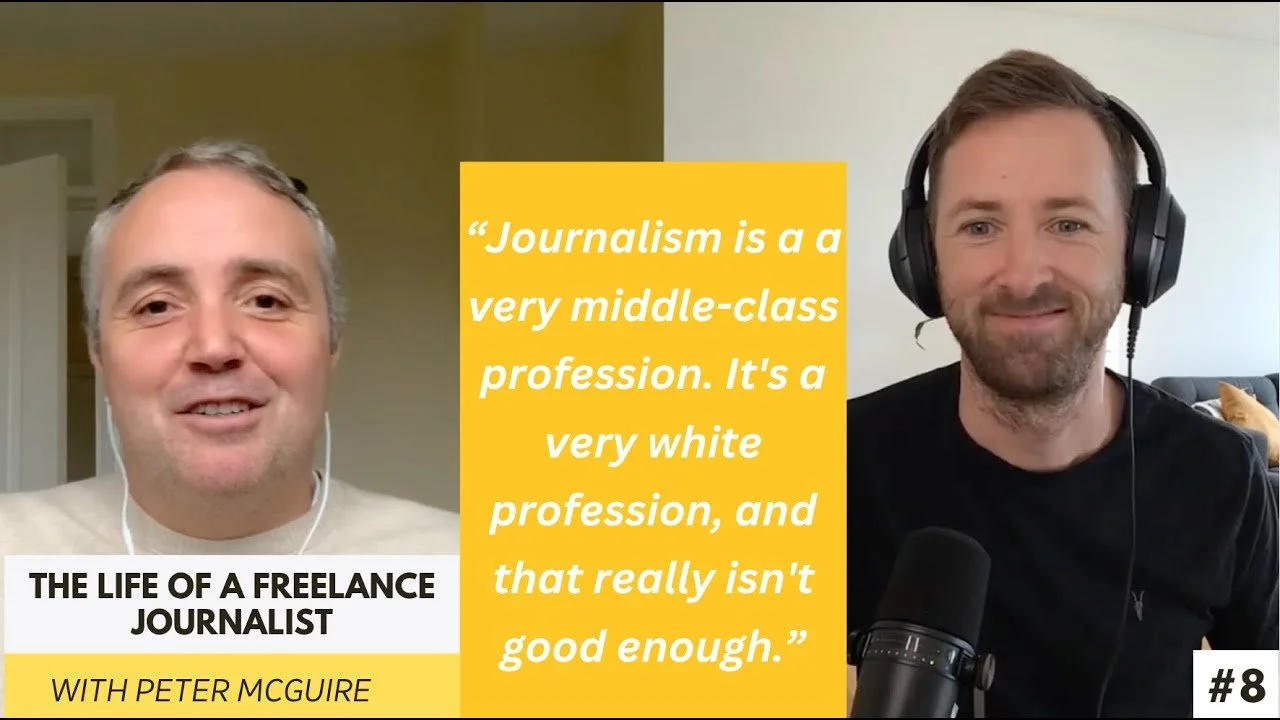
In this podcast, Peter McGuire, a multi-award-winning freelance journalist with 25 years of experience, talks about his journey into journalism and offers insights into the field. He mentions that he initially resisted becoming a writer or journalist, before eventually taking the step to work for a local newspaper.
Peter attributes his ability to sustain a freelance journalism career to several factors—such as the importance of having good contacts, knowing how to pitch the work and being adaptable to different styles of writing. He acknowledges that some freelancers need to transition into other roles, such as public relations, due to financial constraints.
He also highlights the flexibility and freedom that freelancing offers, expressing his preference for this lifestyle over a traditional 9-to-5 job, however, he also recognises that freelance work isn't for everyone, as many people thrive on the structure and stability of regular employment.

In this interview, we speak with Victor Soto, a sales leader with a passion for helping people become the best version of themselves both inside and outside the workplace.
He shares his valuable insights on the importance of building trust, setting clear expectations, and fostering strong team dynamics, even when the team is spread out across different locations.
When he’s not working as a sales leader, he’s driving his passion project of a men’s circle—which is a trusting space for men to talk freely and openly, and connect with other like-minded individuals.

In this interview video, we're chatting with Federico Melandri, an Italian architect who's been working in Lisbon since 2012. He runs his own studio, focusing on residential architecture projects.
Federico discusses the importance of sustainability and durability in architectural projects and emphasizes the need for good social skills and passion for the work. He encourages architects to continuously learn and draw inspiration from various sources, including fellow architects and diverse architectural styles.

In this video, career coach Ronan Kennedy interviews his friend Niels about his career journey so far.
Niels shares his experience as a day trader on the stock market and his journey of starting a software company. He discusses the challenges and risks involved in day trading and emphasizes the importance of not giving up. He also talks about the psychology behind trading and gives advice to those interested in pursuing a career in the field.
He shares his own experience of building an app and the challenges he faced in hiring and managing a team of software developers.

Amanda Perkins is a freelancer who offers delivery excellence, business analysis and salesforce consulting.
In this interview, Amanda discusses career changes & passion projects, working at Salesforce, and consulting for companies remotely.
She is passionate about empowering women to build long-term wealth and regularly presents to her own women in finance group.
Find out more about Amanda or contact her here: aperkinsconsulting.com

Terra has run a business supporting online entrepreneurs with technology and marketing. In that role, she's performed every job a business needs to grow, from planning and marketing to client support and project management.
In this interview, I spoke to Terra Milo about why she started freelancing, what she learned on the way, her journey to her new job and some of her top tips for landing a new role. You can find out more about Terra here: https://insidious-ulna-80e.notion.site/Terra-Milo-Portfolio-d19a38f49ed449a08f9ea9d708eb4338

Dalaney is a Marketing Psychologist, Online Business Strategist and Co-founder of Untapped, a company that guides Evolutionary Experts to scale their business, impact and community.
In this interview, Dalaney talks about impact-led work, finding your purpose and the growing market for all types of coaches and consultants. He also discusses his career path to date and the changes and revelations he had on his journey.
Website: www.untapped.nz/
Follow Untapped on Instagram: @untappedhq
And Dalaney on Instagram: @Dalaney_davis

Recently, I've partnered with EnhanCV—the best CV-building software on the market. They've allowed me to share their software for free.
If you're interested in 6 months of free access, please fill in the form below.
When I register an account for you, you will receive an email from Alex at EnhanCV.
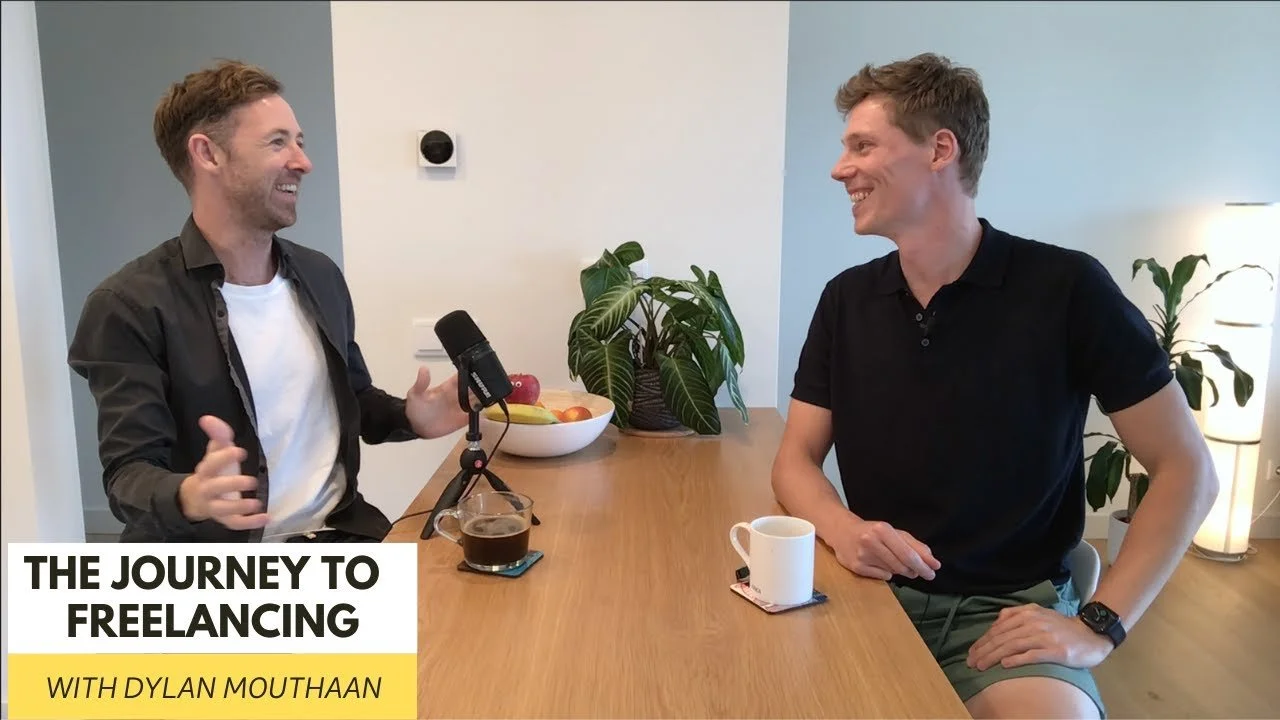
In this video, I spoke to one of my friends, Dylan Mouthaan, about his career so far and his transition from working in the corporate world to life as a freelance digital marketer.
We discussed topics like financial risk, the challenges and benefits of freelancing and his top tips for making the change. You can find out more about him here: dylanmouthaan.nl

In this video, I discuss the pros and cons of CV Builder: Resume.io. It offers both free and premium versions and is super easy to use. It’s one of the more cost-effective options on the market but doesn’t provide completely filled-in templates, which I find helpful.
Take a look at the video to find out more:

Are you tired of the endless hours of CV formatting or the struggle of trying to come up with the right phrases to describe your experience? Or do you dread the task of selling yourself on paper? Well, this may be the solution to all those problems. Online CV-building software is easy-to-use, time-saving and effective.

In this video, I outline the benefits and features of EnhancCV. Check out the website here: enhancv.com.
It offers both free and premium versions and is super intuitive to use. It also allows you to create a matching cover letter for simply sharing the link with your friends for feedback.
I really liked using this CV builder and would recommend it.

Visual CV is a very nice, intuitive piece of CV-building software with both free and premium options. I found it super simple and easy to use and lots of nice designs. You probably will have to pay for it if you're planning on downloading the Word files or if you don't want branding on your documents. www.visualcv.com

Here is a review of Kickresume—a CV (resume) builder that allows you to design, format, write and download a graphically designed CV. It also provides cover letter and resignation letter assistance and has a built-in AI feature that removes the difficulty of coming up with the content on your own.

This is a live, online workshop on the best tips and techniques for creating an effective cover letter, focusing on content and tailoring it for a specific job or industry. You'll learn about the structure of a cover letter and the 5 main points that should be included in it. Also, I'll touch on a little-used tactic for getting the attention of any employer!

This is a live, online workshop on the best tips and techniques for creating an effective CV, including everything from formatting and content to tailoring it for a specific job or industry. You'll Learn: - How to distinguish your CV from your cover letter - The best way to "sell yourself" in writing - Two common mistakes to avoid in your career summary - Make your applications eye-catching through powerful verbs and phrases - Tips for tailoring your applications to specific jobs - How to give weight to your experience and achievements

Often, when people want to change jobs, one of the main difficulties they face involves feeling stuck in the same position because it’s all they’ve ever done. And while this may be true in some instances, it’s not true that they don’t have any skills that could be used in other positions — transferable skills in other words. Remember that whenever you go to a new workplace or company, you have to learn the details of the new position.

By far the most common problem I encounter in the job search is a lack of clarity. If you find that you don’t like any of the jobs, then describe what the ideal job would look like in detail, before searching for it. If you feel like you’ve followed all of these instructions fully and still can’t find something you’re interested in, there could be a couple of reasons for this, and maybe we need to go deeper again. I hope you’re starting to see that the best strategy is the one you create by deciphering what search criteria work best for you. To do this effectively, I encourage you to listen very carefully to what you like or don’t like about any given position. Then, use that feedback to update your search criteria. A word of caution: if you find yourself saying, 'no' to most or all of the roles, then something is radically wrong. Here are some common problems and solutions. If you find yourself:

Quitting is a job can be difficult. We worry about the consequences for our career, the rebuttal from our manager, and perhaps most of all, the awkward conversation. Lots of different thoughts can go through your mind from, “what if they ask me to stay?”, and “what if they offer me a different position that I don’t want?”, to “what if they guilt me into staying for another few months?”, and “what should I do if they promise me there will be changes, when I know that in reality nothing will change?”. And so on… But how can you deal with this situation?

Commercial Awareness is worth clarifying. It relates to the ability to increase revenue or reduce costs. You could also think of it in terms of understanding the cost/benefit of undertaking an initiative or plan. Is it worth your while? Is it worth the risk? Does the organisation stand to benefit from it more than the cost?

Competency-based interviews are aimed at finding out if you can demonstrate your abilities by describing past professional experiences. Every time you hear a question that starts with "tell me a time when…" or "could you give me an example of…", you're being asked about your experiences. Many people will wonder how much detail they should go into — the answer is to be detailed yet concise while sticking to what's relevant. A good rule of thumb is to provide as much detail as possible once it adds value. It's worth having two examples for each question just in case the interviewer asks for another — it's not the sort of question you want to get stumped on. Also, it's best to use a set structure for your answers, such as the STAR model: